Most people buy a book light for one reason: to read in bed without waking anyone else. It sounds like an easy job. Then the light arrives, you clip it on, and twenty minutes later your eyes are watering, the page looks like a mirror, and you are wide awake at half past midnight wondering why you feel so wired.
The light is rarely the problem. The setup is. Book lights are small, bright and very close to your face, which makes them unusually easy to get wrong. Three faults cause most of the trouble: glare, colour temperature and position. Fix those and a book light becomes one of the quietest, kindest bits of kit you own.
Glare: the fault you feel before you notice it
Glare is any light that reaches your eye directly instead of bouncing off the paper. With a book light it comes from two places. The first is the LED itself, sitting at the edge of your vision. The second is the page. Coated or glossy paper behaves a little like a mirror, and light aimed straight at it reflects straight back at you.
The signs build slowly, which is why they are easy to miss. You tilt the book away from your face. The white page starts to look more grey than white, and the text seems thinner than it did an hour ago. By page twenty you have a dull ache behind your eyes and you have adjusted the clip four times.
How to knock glare back
- Rotate the head until you can no longer see the LED or a bright rim of it. On most lights the head swivels, and a small turn makes a large difference.
- Move the light further from the page, roughly 15 to 25 cm, and turn the brightness down. Light spreads as it travels, so a dimmer setting at a distance looks softer than a bright setting up close.
- Aim across the page rather than straight down at it. Side-on light skims the paper, lights the text, and sends most of the reflection away from your eyes.
- Tilt the book a few degrees one way, then the other. If a white band of reflected light sweeps across the text, shift the light to the other side of the page.
- Keep glossy magazines and laminated maps for daylight. They will glare under almost any small LED.
Colour temperature: warm beats brilliant at bedtime
Colour temperature is measured in kelvin, and the numbers matter less than the feel. Cool white lights tend to sit around 5,000 to 6,500K and look crisp and blue-ish. Warm lights sit near 2,700 to 3,000K and look closer to a candle or an old filament bulb. Amber settings go lower still, often around 1,800K, and look distinctly orange.
Cool light has its place. It is excellent for reading a map in a tent, finishing a crossword at the kitchen table, or finding your keys at the bottom of a bag. The mistake is using it in a dark bedroom at eleven o'clock. A blue-white beam on a white page, with nothing else lit, is the brightest and starkest thing in the room, and it tends to leave you feeling more alert than you did before you opened the book.
If your light has a colour button, cycle through the settings before you settle in and note how many presses get you to the warm or amber end. Some lights remember the last setting; some do not, and there is nothing more irritating than realising at midnight that you have been reading under cool white for a week. If you read for hours and still struggle to fall asleep, mention it to your GP rather than trying to solve it with a lamp.
Positioning mistakes that ruin an otherwise good light
Where the light sits matters as much as how it is set. A light held above eye level throws brightness down towards your retina; the same light held below eye level mostly lands on the page instead.
Common placement errors
- Too close to the text. A light sitting a few centimetres from the page creates a hotspot in the middle and dark corners at the edges, so your eye keeps readjusting as it crosses each line.
- Pointed at your face. The head should angle down and across. If you can see the bulb while looking straight ahead, it is aimed wrong.
- Clipped to a floppy cover. Soft covers and dust jackets let the light droop as you read. Clip to the stiffest part of the board and test it with the book open at its thickest point.
- Flooding the room. Wide beams wake partners and cancel out the point of a book light. A hooded or recessed head keeps the beam narrow and the spill low.
- Doubling up on an e-reader. E-readers have their own front light. Adding a clip-on over the top gives you two lights fighting each other, which is a quick route to glare.
- Ignoring your reading position. If you read lying on your side, the light needs to sit along the lower edge of the book. The clip position that worked while sitting up will shine straight across the bed.
Brightness, contrast and the rest of the room
Most book lights arrive set to maximum, and in a dark room that is usually two or three steps too bright. Start at the lowest setting where the text is comfortable, read a paragraph, then decide whether you need more. Your eyes adapt to whatever is brightest in view. When the page is a glowing rectangle in an otherwise black room, everything else becomes darker by comparison and every glance away feels like a jolt.
A little ambient light solves this. A lamp across the room on its lowest setting, a hallway light left on, or a dim bedside light behind you softens the contrast without waking anyone. If a light flickers or buzzes at its dimmest setting, that is usually down to cheap dimming rather than anything you are doing wrong.
A five-minute setup routine
- Clip the light to the stiffest part of the book, near the top or bottom edge rather than the middle of the spine.
- Set it to the warmest, dimmest option and switch it on.
- Rotate the head until the beam runs across the page and the LED is out of sight.
- Pull the light back to roughly 15 to 25 cm and adjust until the text is evenly lit with no hotspot.
- Tilt the book gently left and right, then move the light to whichever side kills the reflection.
- Look around the room. If light is landing on the wall, the pillow or the person beside you, narrow the beam or hood the head.
- Read one full page. If you squint, shift position or feel your eyes working, change one thing and try again.
Small habits that keep night reading comfortable
Good setup does most of the work, but a few habits carry it further. Keep the light on one side of the page rather than straddling the middle. Charge the light during the evening rather than at bedtime, so you are not finishing a chapter on a dying battery at full brightness. Take a short break every half hour or so and look at something across the room, which gives your focusing muscles a rest.
If your eyes still strain, or you keep waking unrefreshed despite sensible lighting, see an optician or your GP rather than buying another lamp. A warm, dim, well-angled pool of light on the page
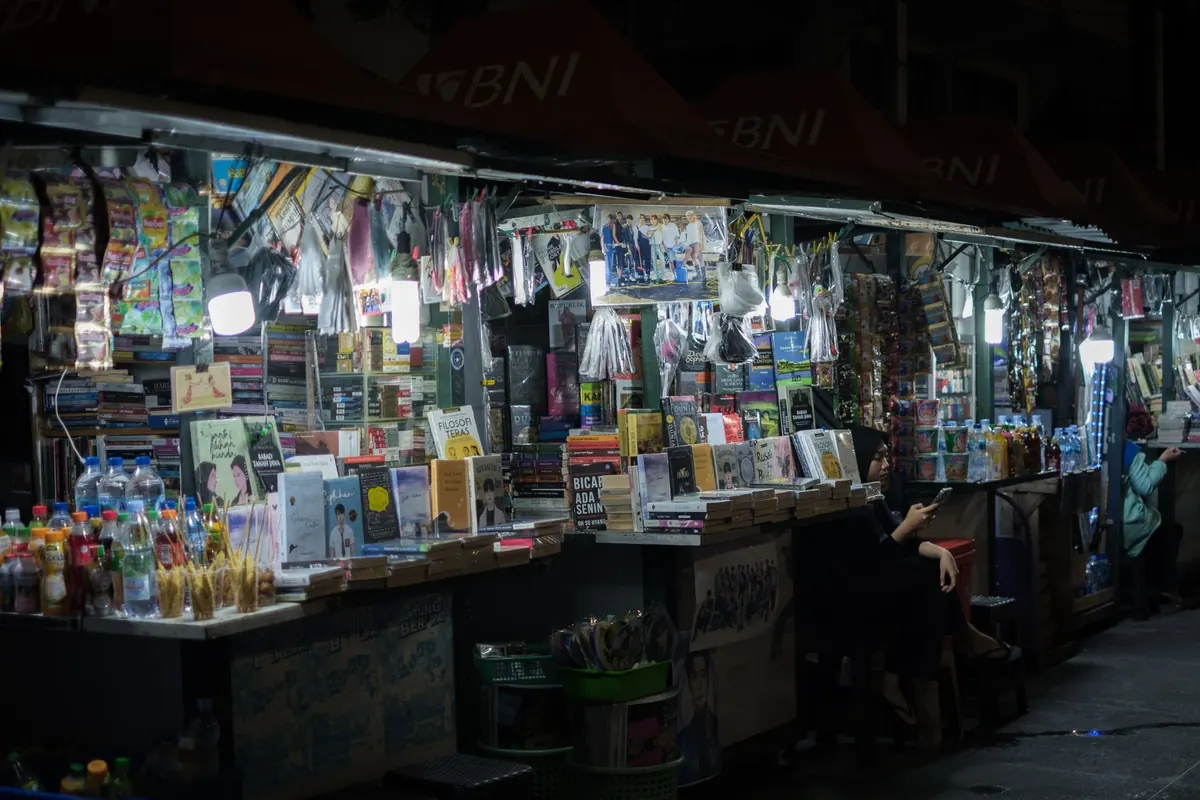
Photo: Lutfi Elyas / Pexels